Arts in Germany over Anguish in Kabul: Kimia’s Colorful New Start
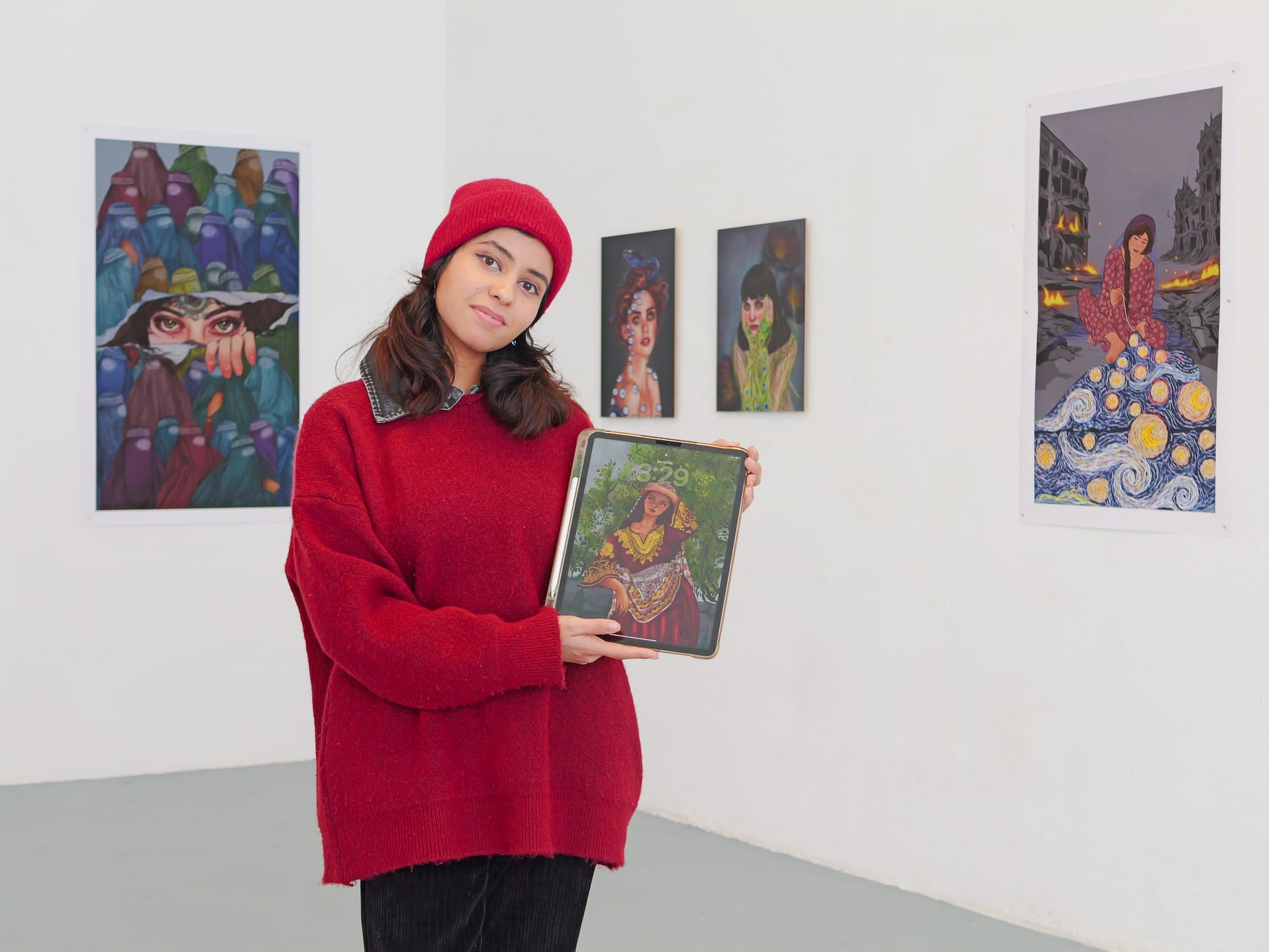
The Afghan artist Kimia has barely arrived in Germany when she holds her debut exhibition in Nürtingen. The 26-year-old shows her audience impressive messages.
- Autor:in
- Mehr Beiträge
The gaze of these eyes gets through everything. The green tint in the pupils immediately captivates the viewer. Not much more can be seen of the woman who is about to make her way out of the picture. She is looking through the crack in a drawing showing women covered in burqas. Four fingers stick out as if the woman wants to break out of this anonymous mass. Strands of hair stick out as if a wind is blowing. A closer look reveals a tear on the right cheek.
For visitors to the Nürtingen showroom, this direct eye contact is their first encounter with the works of artist Kimia1Kimia means “alchemy” in Persian: the author’s intention is to express the transformation of ordinary objects into something valuable. The protagonist of a well-known novel also bears the first name. (artist’s name). The 26-year-old Afghan woman has succeeded in doing exactly what her protagonist is striving for: Escaping the oppression of a reign of terror, breaking out into freedom. “Resilience and Restart” is the fitting title of her premiere exhibition in the showroom of the Kunstverein Provisorium Nürtingen in Germany.
An anxious wait in Pakistan
Kimia’s ordeal only ended in December 2025 with her arrival in Germany. She remained under the Taliban regime in Afghanistan for three years until she was allowed to leave for Pakistan. She had to hide in a guest house there for months to avoid deportation in the face of an escalating political situation. “It was a very stressful time,” says Kimia looking back. Thanks to German supporters, she was then allowed to enter the country via the Federal Reception Program – and start a new life:
I can finally draw and breathe freely. It feels so good. It’s important for everyone to live in a free place. Freedom is like a gift from god.
Around 100,000 people from all over the world now follow Kimia on Instagram. However, she had to suspend her activities for several months: When a post of hers received a lot of attention, she ran at risk of being targeted by the Taliban. “They’re looking for people, it’s really scary,” she says. Before that could happen to her, she looked for a way out. Since she was able to leave Afghanistan, she has been active again. She celebrated her first exhibition in Nürtingen immediately after her arrival.
Art against oppression
She doesn’t actually see herself as a political person, says Kimia: “It’s the political situation that makes it so.” She herself first had to learn that her works were political. As a woman in Afghanistan, art itself is a protest against the rules. As a young artist, Kimia also addressed her own lack of freedom. She studied television journalism in Kabul before the Taliban seized power. After the capital fell into the hands of the islamists, her dreams of a professional career fizzled out.
So Kimia put on canvas and later on digital paper whatever was on her mind. For example, women reading or dancing or with their hair down, actually everyday situations and yet politically charged in their social context. She now directly addresses aspects such as the ban on education or the obligation to wear a veil in Afghanistan. She also addresses other issues that concern her. “In Iran, 42,000 people have died because they want to live the way they want. That’s so crazy!” Kimia gives an exampleThe2interview took place before the US and Israel attacked Iran.
She not only wants to focus on the dramatic situation in Afghanistan, but also use her art to address various situations around the world. “In my mind, we as people should empathize with the pain of others in order to become a strong community,” she says. Politics and religion divide, while art can unite.
A special feature of Kimia’s work is that, as a self-taught artist, she does not follow a fixed pattern. She herself also finds it difficult to put this into words: “I try to use a style that suits me. I just start with a sketch.” After all, she still has time to develop artistically.
New perspectives
Till Ansgar Baumhauer finds it difficult to classify her drawings according to the criteria commonly used in this country. He teaches practice and theory of the visual arts as a professor at the Nürtingen University of Applied Sciences. “Kimia’s aesthetics offer a low entry threshold,” says Baumhauer. Her works can be read and understood immediately, even without a background in art history: “This is art for a large social group. This is its strength.”
Baumhauer supported and sponsored the artist privately. Among other things, he rented and financed an apartment for more than a year to enable her long, uncertain and difficult entry into the country. Between 2009 and 2011, he visited Afghanistan himself several times as an archaeological draftsman. For his artistic doctorate, he then focused on the visualization of war experiences in long-term conflicts using the examples of the Thirty Years’ War in the Holy Roman Empire of the German Nation and the decades-long conflicts in Afghanistan. Based on this experience, he says that viewers need to take off their “contemporary European glasses” in order to better understand works of art that originated in Afghanistan, for example.
The best example is the work of a woman embroidering a blanket with van Gogh’s starry sky motif in the middle of a burning war zone. This reference may seem familiar to European viewers, especially as the author’s biography has given him a controversial role as an artist. However, the art professor explains that such a professional approach to interpretation comes from the wrong direction: “As viewers, we bring this inside. For Kimia, it is beauty, harmony, calm and peace.” Her point of view is crucial for an appropriate assessment of Kimia’s work.
This premise may explain why many of Kimia’s followers come from Afghanistan, Turkey, Iran and India. They tend to be better able to empathize with the artist’s perspective due to their own experiences. Her figuration and realism are already well received here.
Connecting the old with the new
When the art professor curated the exhibition in Nürtingen for the Provisorium art association together with Karin Rehm, he still had reservations as to whether the works would be convincing in terms of design, beyond their authenticity and message. Many of the works were initially only available in digital form because Kimia was only able to work on her tablet out of necessity. She had to leave early works behind in Kabul and hide them from the Taliban. However, Baumhauer is convinced that they are also effective for a German audience. “The works are so strong that they can stand on their own. They put their finger in the wound and make grievances visible,” he says.
From this point of view, the professor particularly likes the three hand-drawn portraits: on the one hand, there is the female, Afghan perspective on art and aesthetics that Kimia makes visible. Secondly, they can now be viewed in a reciprocal cultural context, as the self-taught artist was inspired by various influences. The fact that some of the Afghan’s older works may not yet be quite as pointed and technically sophisticated underlines the rapid artistic development of the talented 26-year-old.
For Kimia, the art professor now sees the challenge of asserting herself in a difficult international market. “Her chance here is not to bend, not to adapt to Western aesthetics in advance. The big challenge is to combine the old and the new home,” says Baumhauer. There are also aspects such as the extreme portrait format that the artist has used as a platform for Instagram to date – which is unusual in an analog world, however. The animations with musical accompaniment that Kimia works with also offer technical potential. “I’m really excited to see where she will develop,” says the art professor.
Second separation from the family
In addition to current events such as the struggles for freedom in Afghanistan, Kurdistan and Iran, Kimia’s own biography also offers numerous starting points for further works. The price for her life in freedom was living with her family, who had to stay behind in Afghanistan. The extremist ideology of the Taliban separated her from her father for the second time: during the first reign of terror, he worked in Russia, where he had previously studied, due to a lack of prospects. He only returned to the family permanently when Kimia was twelve years old. For her, this was “like a rebirth”. Now she is the one leaving the country. “The first time I had no father, the second time I have no family,” says the 26-year-old. Many Afghans share this fate.
The joy of freedom is mixed with the loss of family and concern for loved ones and the millions of oppressed girls and women. “You live through them and you can’t leave that behind,” says the artist: “I know how hard it is to live under these crazy rules. The connection remains.” It is precisely these “stupid rules” that she does not want to accept and wants to be a voice against.
International interest
Kimia has already achieved one goal with her art: it is finding favor around the globe. From Kabul to Islamabad and Nürtingen, it could soon be on its way to Paris and New York. “It feels great to accompany her at the start,” says co-curator Karin Rehm and emphasizes the importance of the works: “Kimia reminds us to connect with each other as human beings.”
For Kimia in Nürtingen, meanwhile, it is also completely new impressions that will influence her in her future work. “I really enjoy going to a café and seeing older women meeting up,” says the 26-year-old. Such everyday scenes, which are taken for granted in Germany, are unthinkable in Afghanistan and show her that she lives in a safe place.
After all the setbacks, the 26-year-old is now showing signs of optimism. “I can connect with a new environment. That makes me a new, strong person,” she says. She can hardly wait for the day when the millions of Afghan women can also feel this freedom. Her biography shows how far hope can take one.
Footnotes
- 1Kimia means “alchemy” in Persian: the author’s intention is to express the transformation of ordinary objects into something valuable. The protagonist of a well-known novel also bears the first name.
- 2interview took place before the US and Israel attacked Iran.
Post published on March 8, 2026
Last edited on March 8, 2026
- Autor:in
- Mehr Beiträge
[mc4wp_form id=239488]
Leave a Reply
You must be logged in to post a comment.